
 Delete Article!
KISTI-KAIST Develop Molecular Design Technology to Improve Blue OLED Lifetime
배혜림 2026-01-15 View. 291,943 https://pubs.acs.org/doi/10.1021/acsomega.5c09501KISTI-KAIST Develop Molecular Design Technology to Improve Blue OLED Lifetime
- Identified degradation mechanisms in emissive materials and selectively enhanced stability while maintaining color
- Proposed six new highly stable blue-emitting materials compatible with existing device structures
□ The Korea Institute of Science and Technology Information (President Sik Lee, hereafter KISTI) and Senior Researcher Dr. Jaewook Kim of KISTI’sSupercomputing Acceleration Research Division, together with Professor Woo Youn Kim of the Department of Chemistry at the Korea Advanced Institute of Science and Technology (President Kwang-Hyung Lee, hereafter KAIST), have developed a molecular design technology that significantly extends the operational lifetime of deep-blue organic light-emitting diodes (OLEDs) by improving the stability of blue emissive materials.
□ This technology, once commercialized, could enable high-efficiency replacements for currently low-efficiency blue OLEDs, reducing power consumption and extending the lifetime of display devices.
□ OLEDs are self-emissive display devices that use organic materials and are known for their bright images, excellent contrast, and low power consumption. Unlike red and green OLEDs, however, blue OLEDs have struggled with short material lifetimes despite intensive research, making this a long-standing challenge for the display industry.
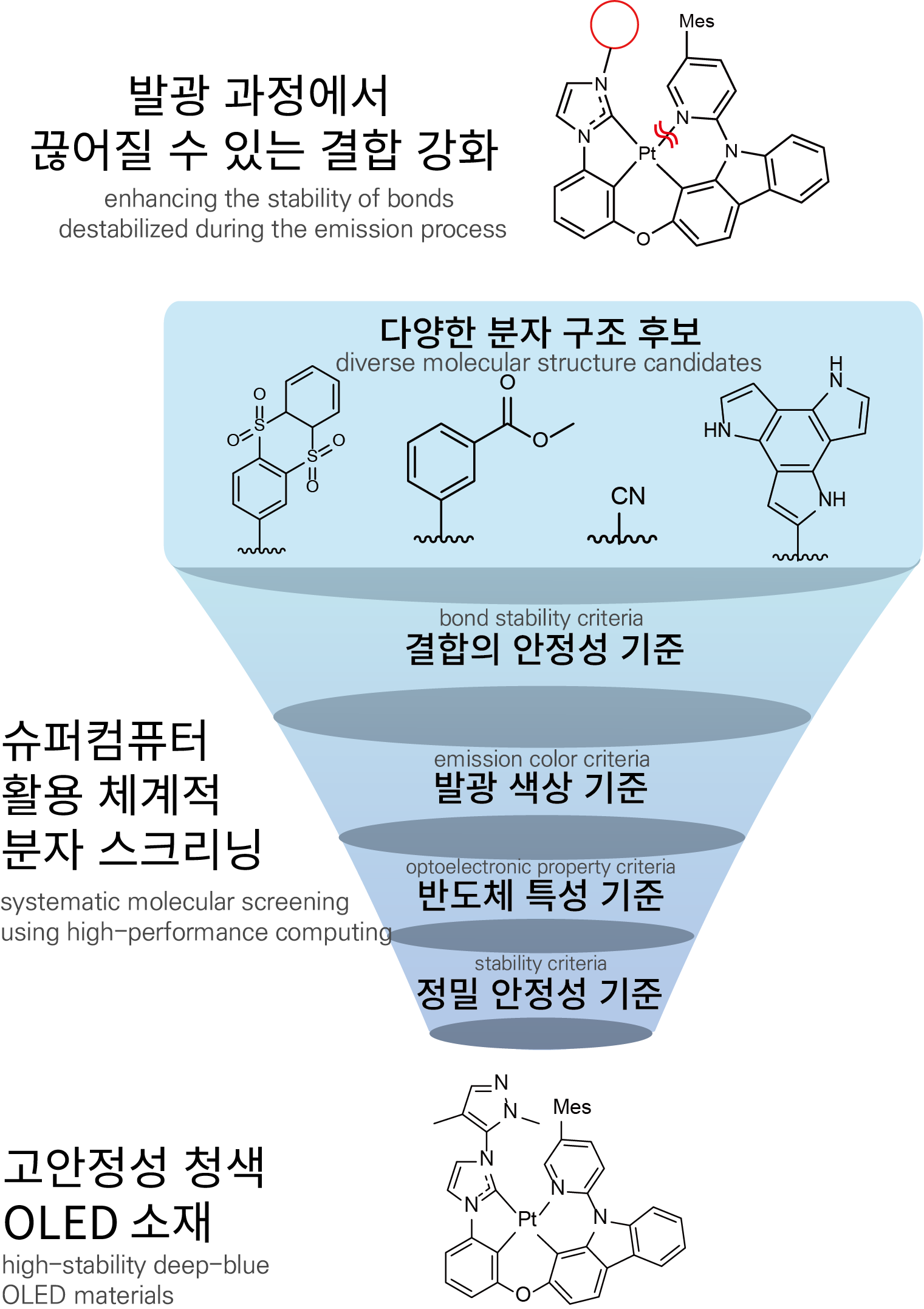
□ The research team discovered that specific chemical bonds within platinum-based high-efficiency blue emissive materials break during the light emission process, leading to degradation and reduced lifetime. Based on this finding, the team proposed a molecular design principle that selectively strengthens these vulnerable bonds while preserving the emission color.
□ Using KISTI’s fifth national supercomputer “Nurion,” the researchers systematically evaluated over 100 molecular structures and identified six new blue emissive material candidates that can be immediately implemented with existing OLED manufacturing processes. These new materials exhibit approximately twice the stability of conventional materials while maintaining deep-blue emission characteristics.
□ Professor Woo Youn Kim of KAIST explained, “The short lifetime of blue OLEDs has been a longstanding issue in the display industry. This study is significant because it presents a molecular design principle that selectively improves stability without altering the emission color.”
□ Dr. Minjoong Jeong, Director of the Supercomputing Acceleration Research Center at KISTI, added, “The systematic molecular screening using the national supercomputer was the core of this research. By combining this with future AI-based material discovery techniques, we expect to accelerate the discovery of new emissive materials even further.”
□ The study was conducted with support from the Korea Institute for Advancement of Technology (KIAT), the National Research Foundation of Korea (NRF), the National Research Council of Science & Technology (NST), and the KISTI National Supercomputing Center.
□ Publication Details
○ Title: Engineering Excited States of Pt-Based Deep-Blue Phosphors to Enhance OLED Stability(doi.org/10.1021/acsomega.5c09501)
○ Journal: ACS Omega, Volume 10, Issue 46 (2025)
○ Authors: Yongjun Kim, Jaewook Kim, and Woo Youn Kim
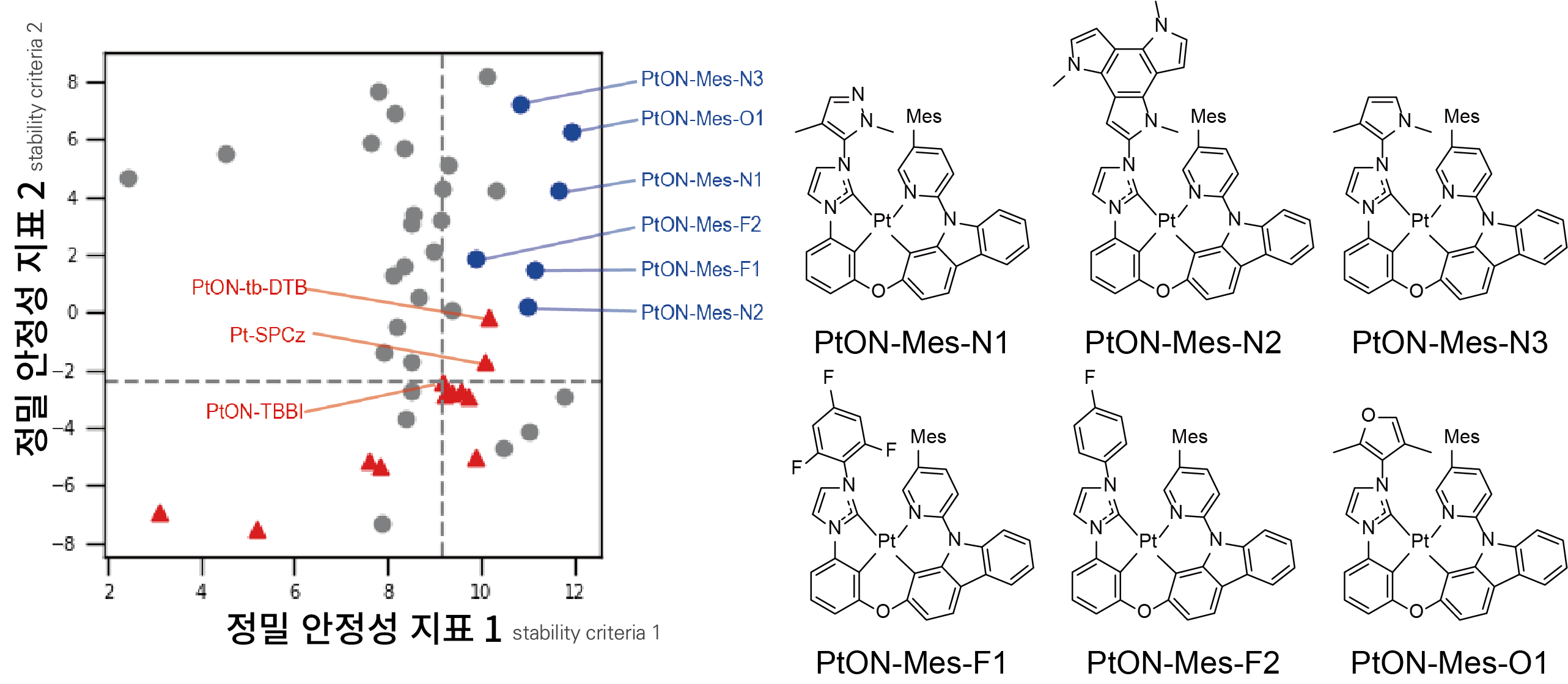
(Top) Comparison of the stability of blue emitters.
The red dots represent previously reported emitters, while the blue dots indicate the six blue emitters proposed in this study, which exhibit higher stability than existing materials.
(Bottom) Molecular structures of the six blue emitters proposed in this study.
Attached files(2)
 [attachment] photo 1.png