
 Delete Article!
-
292009. 06
No. 20 View. 20740

KISTI hosts a conference "The Clouds 2009"
'K-cloud' makes a startConference "The Clouds 2009" on July 8 - Discussion on standardization policy Korea Institute of Science and Technology Information(KISTI, President Park Young-seo) will hold a conference "The Clouds 2009" in cooperation with Korea Cloud Service Association, Korea IT Service Industry Association, Cloud Computing Forum, and The Electronic Times at the COEX Intercontinental Hotel Seoul on July 8. The conference's aim is to gather, analyze and propagate the technological information related with Cloud Computing, research and analyze the latency information of Cloud Computing and support new policy for Government as well. More than 500 attendants include computing analysts and participants interested in cloud service. The sailing ceremony of 'Cloud Computing Forum' will also be held as the first step of K-cloud on the same day. This forum, in which KISTI and Association of Next Generation computing Industry, and others are participated, plans to conduct standardization policy researches on Cloud Computing. Cloud Computing is one of the most promising IT concepts, which is when users run software over the internet and access it via a browser. It is a style of computing in which dynamically scalable and often virtualized resources are provided as a service over the Internet.The term cloud is used as a metaphor for the Internet, based on how the Internet is depicted in computer network diagrams and is an abstraction for the complex infrastructure it conceals. -
262009. 06
No. 19 View. 21723
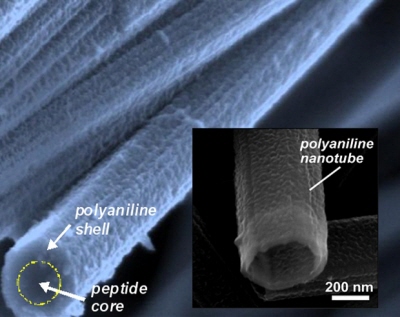
KAIST develops conducting nanowire
Prof. Park Chan-beum's team uses peptide self-assembly tech, publishes study in international journal. (Photo) Image of vertically well-aligned nanowire and nanotube.A team of Korean researchers has developed conducting polymer nanowire and nanotube material that employ natural peptide self-assembly technology. The Korea Advanced Institute of Science and Technology (President Suh Nam-pyo) said on June 15 that a team led by Prof. Park Chan-beum at KAIST's department of materials science and researcher Ryu Jung-ki had published their study on the development of conducting polymer nanowire and nanotube material in Angewandte Chemie, a world-renowned chemistry journal. Peptides or proteins can create three-dimensional structures through the combination of some 20 amino acids. Such structures have the advantage of outstanding physical characters and diverse functions, which were not available in the original materials. The research team allowed tens of thousands of very simple peptides comprising two amino acids to align on their own to successfully form a long nanowire one one-thousandth the thickness of a single hair. They then coated the structure with polyaniline, a conducting polymer material, to create a Vertically Well-Aligned conducting Nanowire. Unlike common electric wires, the Vertically Well-Aligned nanowire only conducts electricity on its surface. Prof. Park's team then selectively removed the peptide core section of the conducting nanowire to produce a conducting nanotube consisting purely of polyaniline.Creating three-dimensional structures through the self-assembly of chemical substances, a process not unlike building with Lego blocks, not only constitutes a fundamental mechanism within all different biological phenomena, but is also widely sought after as one of the key technologies for producing nanomaterials. Notably, since the peptide the research team used in the study originated from amyloid plaque in a fabric structure, which is closely related with the development of degenerative diseases including Alzheimer's, the study of the self-assembly of peptides is highly important from a medical perspective as well. If conducting polymer is produced into a nano-sized structure, its electric characteristic is significantly enhanced. Hence, the newly developed conducting nanowire and nanotube will likely find applications in the development of various next-generation solar cells, sensors and chips, and are expected to help boost Korea's science and technology competitiveness in the areas of nano-bio fusion in the future.Meanwhile, experts say the newly developed technology has already made important contributions to the development of nanomaterials through the creative fusion of nanotechnology and bioscience.Lim Eun-heeredant645 at Hellodd.com(Photo) From left: Prof. Park Chan-beum and Ph.D. candidate Ryu Jung-ki, researcher[June 26, 2009]- - - - - - -Source - HelloDD.com -
222009. 06
No. 18 View. 22498
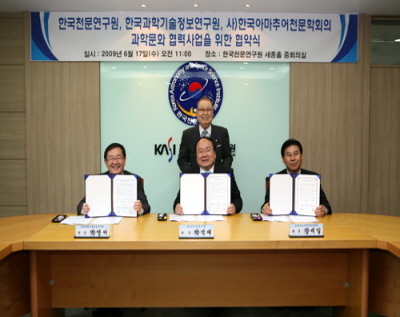
KISTI signs MOU with KASI and KAAS
Korea Institute of Science and Technology Information(KISTI, President Park Young-seo) has concluded a memorandum of understanding on science culture cooperation with Korea Astronomy and Space Science Institute(KASI, President Park Seok-jae) and The Korean Armature Astronomical Society(KAAS, President Jang Se-il). The signing ceremony was held at KASI in Daejeon on June 17, 2009. Under the MoU, KISTI, KASI, and KAAS have agreed to cooperate and collaborate for promotion of SETI Korea(Search for Extraterrestrial Intelligence, Korea), a distributed computing(grid computing) project of KISTI using Internet-connected computers. -
182009. 06
No. 17 View. 22699
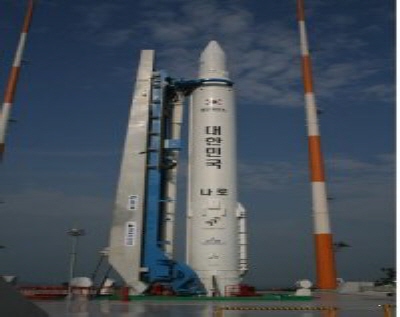
Korean Satellite Rocket 'Naro-ho' Close to Lift-off
President Lee Myung-bak says "Korea aims to be one of world's top seven space powerhouses in ten years" The nation will see a Korean satellite blast off at a space center built by Korean scientists and engineers as early as late July.At the June 11th inaugural ceremony for the Naro Space Center in Oenaro-do, Yenae-ri, Bongrae-myeon, Goheung-gun, South Jeolla Province, officials from the Ministry of Education, Science and Technology announced, "Korea will launch the 'Naro-ho' (Korea Space Launch Vehicle-1, or KLSV-1), Korea's first satellite rocket, in late July." With the inauguration of the Naro Space Center, Korea became the 13th country in the world to operate a space center. If the Naro-ho is successfully launched, the country will become the world's tenth nation to send a self-developed satellite into orbit. Korea becomes 13th country to operate space center (Photo)The launch pad, standing 33 meters tall, is equipped with a rocket model for performance testing. In his congratulatory remarks at the ceremony, President Lee Myung-bak said, "Korea will continue to invest in research and development for space exploration to usher in a space era on our own in ten years, and become one of the world's top seven space powerhouses." "Fifty years ago, when the U.S., Russia and Europe were advancing into space, Korea was still struggling to overcome poverty and hunger; sending men to the moon seemed to have nothing to do with Koreans," Lee said. "However, Korea has now completed a space center, something operated by only ten countries throughout the world, less than 20 years since we began a space development program, an achievement that we are truly proud of." "Korea will be able to send astronauts into space and to the moon using our own technology in the not-so-distant future," President Lee said, adding, "In order for us to do so, we must speed up the development of a Korean-style rocket launcher based on technology that we have acquired and developed on our own thus far." Urging his fellow citizens to shoot for the stars and embrace a new future for the nation, the president said the successful launch of Naro-ho (KLSV-1), set for late July, would serve as a turning point for Korea to usher in a space era banking on homegrown technology. The ceremony brought together more than 1,000 people, including government officials, lawmakers, senior officials from regional and local governments, and local residents. Korea broke ground on the space center in December 2000, and invested 312.4 billion won over the past eight years to complete the facility. Naro Space Center chief, Min Kyung-joo, said in his progress report, "In the beginning, our researchers relied on Russian technology, but we gradually installed the launch and control facilities using Korea's own technology, and completed performance tests through testing on 14 occasions." Min said the center is conducting launch pad validation testing using a ground validation launch pad, and aims to complete the test by the end of June. According to the Naro-ho launch schedule, the center will also bring in a first-stage rocket model from Russia in June, and complete a second-stage aviation model later in the month. Laser reflector mounted on satellite Lee Joo-jin, President of the Korea Aerospace Research Institute, said, "With the inauguration of the Naro Space Center, Korea has already passed the development phase in the fields of space center design and construction, and entered a utilization phase." Lee added, "Through the successful launch of the Naro-ho, which is scheduled for late July, we expect Korea will demonstrate its capacity in space center operation technology and the capability of its operators in the utilization phase." Lee also said that during the month of July, Korea will complete the assembly of the stage-1 rocket and a second-stage rocket model that will? be actually lifted off, as well as checking off launch preparations, before launching the Naro-ho in late July. Korea's 'science and technology satellite No. 2,' which will be sent into orbit aboard the Naro-ho, will be moved to the Naro Space Center from the KAIST Space Center at 10 a.m. on July 12. Korea's science and technology satellite No. 2 will circle the earth at low altitude orbit (300 km to 1,500 km) for two years. The satellite was developed jointly by the Korea Aerospace Research Institute, KAIST, the Satellite Technology Research Center, and the Gwangju Institute of Science and Technology beginning in October 2002. The satellite, which was developed using homegrown technology, is of small size, weighing about 100 kg. It is equipped with a microwave radio meter that is capable of measuring humidity in the atmosphere and ocean and that was developed by GIST, and a laser reflector that was developed by KAIST and the Satellite Technology Research Center. Lee Kang-bong,editorial board memberaacc409 at naver.com [June 18, 2009]- - - - - - -Source - ScienceTimes -
112009. 06
No. 16 View. 22557
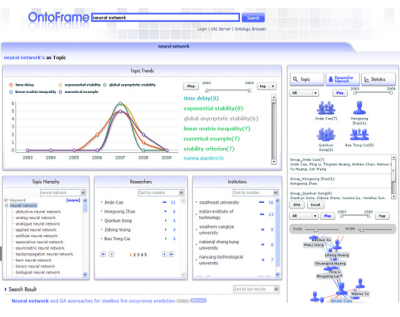
'Artificial Intelligence' to help scientists search science and technology paper...
KISTI unveils 'Prototype Next-Generation Science and Technology Information Service' The Korea Institute of Science and Technology Information (President Park Young-seo) said on June 4 that it has constructed a 'Prototype Next-Generation science and Technology Information Service' using OntoFrame, a Semantic service platform and will unveil the system to the public.'Semantic Web' refers to a cutting-edge web service that allows computers to intelligently understand information and then make logical inferences based on different types of data. Onto Frame is a next-generation search platform using Semantic Web technology that allows the user to search the most relevant information through the continual interlinking and seemingly infinite growth of data. The new 'Prototype Next-Generation Science and Technology Information Service' offers in-depth service for 450,000 scientific journals in the fields of information and biotechnology. Specifically, services made available by the innovative system include news on the latest trends in research topics, experts and research institutes by research topic, networks of research sites, and researchers conducting similar studies, information on which is generally hard to retrieve through conventional reference materials and literature. Additionally, the system classifies search words employed by the user according to whether the word is a research topic of a researcher, and allows the user to generate a viewing format suitable for the given search word, thus enabling him of her to locate the required data easily and conveniently. The 'Prototype Next-Generation Science and Technology Information Service' system?utilities more than 40 patents that are being applied for or are already registered in Korea and elsewhere, and has thus earned recognition for its uniqueness and a high level of comprehensiveness. OntoFrame, which was used as the system's service platform, had been applied to projects for the Korea Research Foundation, the Korean Agency for Technology and Standards, and the Ministry of Justice. Ryu Beom-jong, head of KISTI's information technology research division, said, "The new Prototype Next-Generation Science and Technology Information Service will play a crucial role in upgrading the current search-focused information service based on simple keywords to an advanced information service based on Semantic Web technology, a key element for the Web 3.0 era." Meanwhile, KISTI plans to make public the new system via a website(ontoframe.kr/2008) specially designed for the service, and to gather and compile opinions and assay demand for the system to further improve its NDSL service. Photo] Sample web page of the Prototype Next-Generation Science and Technology Information Service (searched through "neural network") ? Hellodd.comJung Ji-onjion97 at hellodd.com [June 11, 2009]--------------Source - Hellodd.com -
272009. 05
No. 15 View. 23324
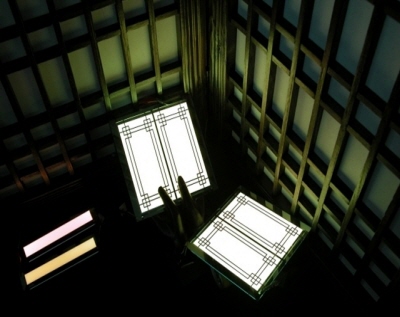
ETRI develops core technology for 'high-efficiency white OLED lighting'
New technology boasts electricity consumption efficiency of over 70 1m/W. Expected to carve out global lighting market niche worth 3 trillion won.(Photo) ETRI-developed OLED lighting, considered on par with Korea's best OLED lighting technology. A Korean research team has developed a core technology for Organic Light Emitting Diode (OLED) lighting, an eco-friendly 'green growth' lighting technology that is replacing conventional florescent lamps and glow lamps.The Electronic and Telecommunications Research Institute (ETRI, President Choi Moon-ki) said on May 20 that it had developed a white OLED lamp for lighting that boasts an electricity consumption efficiency of 70 1m/W, the highest level in Korea. OLED technology is considered an exemplar of "eco-friendly green growth" lighting due to its energy efficiency, which is higher than either florescent lamps or glow lamps, reduced carbon dioxide emission, and non-production of mercury, a by-product of both florescent and glow lamps. Numerous countries around the world are currently racing to develop OLED lighting together with other next-generation lighting devices, including LED lighting. OLED lighting is not only thin and lightweight, but it also offers a transparent and flexible lighting source. Hence, it is a highly versatile technology. with numerous potential applications owing to a host of advantages in terms of its high efficiency, long durability, low cost and lighting design. ETRI said the development is notable in that Korea has now secured a high level of technology in the white OLED lighting sector that is on par with that of advanced countries. Korea had previously been saddled with a more than five-year technology gap in the sector in relation to those countries. Experts say that the development will also allow Korea to join the race for high-performance lighting, which has traditionally been led by advanced countries, and to advance the commercialization of OLED lighting by banking on the new technology. Cho Hye-yong, head of the ETRI's OLED lighting research team, said, "OLED lighting shares the same industry infrastructure and value chain as the OLED display, and if Korea can proactively take advantage of its industrial environment as the top producer of OLED displays, it will be able to dominate the next-generation lighting market." In the meantime, ETRI plans to hold an "OLED lighting design contest" from May 25 to August 31 in an effort to promote and propagate OLED lighting. ETRI will seek to hold the contest as an annual event, and identify talented designers and excellent designs that make the most of OLED technology as a flat lighting source. The Institute expects excellent designs and talented designers will contribute to the early industrialization of OLED lighting by making the most of Korea's superior OLED production infrastructure. The institute plans to make prototype products based on the contest's winning designs, and exhibit them at the "IMID international display exhibition" in October in order to promote OLED lighting. (Photo) Poster for the OLED lighting design contest. ? Hello DD.comLim Eun-heeredant645 at hellodd.com ? [May 27, 2009]- - - - - - -Source - HelloDD.com -
212009. 05
No. 14 View. 22476
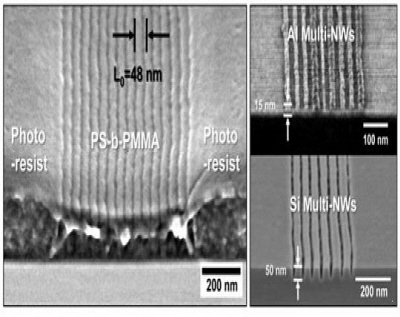
Korean scientists develop new production technology for nanowire, key to develop...
KAIST Professor Kim Sang-wook's team uses molecular assembly nano technology. A new chapter has opened in the production of nanowire, widely considered one of the top 10 technologies that will change the world. A team of researchers led by Prof. Kim Sang-wook at the new materials department of KAIST (President Suh Nam-pyo) said on May 11 that it had developed a new method for arranging polymers that independently form nanopatterns on a large surface, and had also used the method to develop a technique that allows for the easy and convenient production of nanowire at a specific location as required. Kim's team composed a nanostructure that is self-arranged in various forms by filling polymers that formed nanopatterns on their own in micro patterns. The researchers then demonstrated that they could create an aluminum nanowire and silicon semiconductor nanowire on a large surface by using the nanostructure as a template. Moreover, the team successfully measured the electrical characteristics of the aluminum nanowire that was created thorough this process. The result of the study was published in the May 7th online edition of Nano Letters, a world renowned scientific journal in nanotechnology. Steps are now underway for the registration of patents for related technologies. (Photo)Sectional diagram of PS-b-PMMA block polymers in a platy structure which are arranged between photo register patterns, and of aluminum nanowire and silicon nanowire that were created using the structure as a template. One of 10 technologies that will change the future. Nanowire is considered one of 10 technologies that will change the face of the future, and is the most critical factor for the development of cutting-edge electrical and electronic components, including transistors, memories, and sensors for chemical detection. However, the production of a nano-size template using conventional technology has generally been highly costly and time-consuming, creating a need for a new production technology. A researcher with the KAIST team said, "The new technology is expected to be widely used in the production of biosensors and multi-layer nanotransistors." ? ? ScienceTimesKim Chung-hanchkim at kofac.or.kr[May 21, 2009] - - - - - - -Source - ScienceTimes -
212009. 05
No. 13 View. 21508
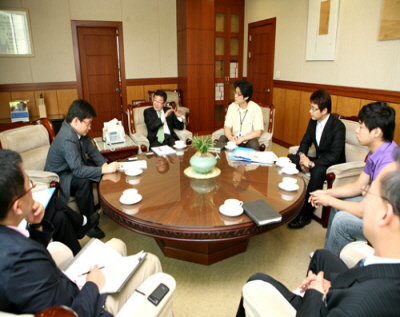
Interview with Intern Researchers of KISTI
There was an interview for a featured article on Intern Research Analysts of Joongang Daily News at KISTI head office in Daejeon on May 7th. Three intern researchers (Lee Youn-soo, Kim Bo-seong and Jo Jin-hee), as well as Dr. Park Young-seo, President, engaged in this interview and talked up the work environment, fields of the study they're working on and their plan for the future.This interview would be an opportunity for considering the working conditions and the difficulties of intern investigators and for collecting their opinions.Dr. Park Young-seo talked about major research achievement of KISTI and at the same time said that it could be great opportunities for interns to act as mediators between Industry and Research.(Photo) Dr. Park Young-seo and Intern researchers -
152009. 05
No. 12 View. 23803
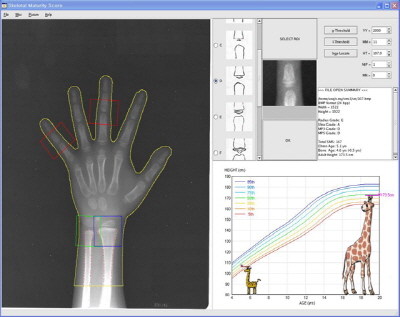
New software predicts 'how tall my child will be'
(Photo) Main page of the new software for predicting children's future growth. ETRI's technology uses X-ray images to analyze physis, forecast child's future height. Korean researchers have developed a new technology that can conveniently and easily predict a child's future height and treat poor growth in children. The Electronic and Telecommunications Research Institute (President Choi Moon-ki) said on May 12 that it had developed 'software for predicting children's growth in height," which allows users to forecast a child's future height by measuring bone maturity via an analysis of his or her physis, or growth plate. The software is also expected to help doctors and parents treat children who are growing poorly. The software is designed to predict a child's bone age and his or her projected height as a grownup by deciphering the maturity of the physis at two spots, including the radioulnar area and the phalanges, that are crucial for measuring the maturity of bones, based on the TW3 hand system, which is said to most accurately represent the maturity of a child. The "child growth prediction system" currently employed at hospitals uses ultrasonic image scanners with poor accuracy, and requires the user to detect the 13 physis one by one, and compare physis images with the standard images. The test is a time-consuming process, and may even provide inconsistent analysis results to different doctors. ETRI expects the new software will help doctors to "treat children who are growing relatively poorly," "predict a child's future height as an adult," "monitor progress in children undergoing growth treatment," and "predict the time for the emergence of second-stage sexual characteristics and conduct diagnosis of sexual pre-maturity," thus creating a new market for treating poor physical growth in children. The technology was developed as part of ETRI's institutional basic project supported by the Ministry of Knowledge Economy. The institute plans to commercialize the technology through a test service for its industrialization and technology transfer. Kim Seung-hwan, head of the u-Health research team, said, "The technology is expected to increase accuracy and reliability in predicting children's physical growth, and serve as a catalyst for activating the related market, including physical growth clinics." ? Hello DD.comJung Ji-eun,jion97 at hellodd.com ? ? ? [May 15, 2009] - - - - - - -Source - HelloDD.com -
062009. 05
No. 11 View. 22241
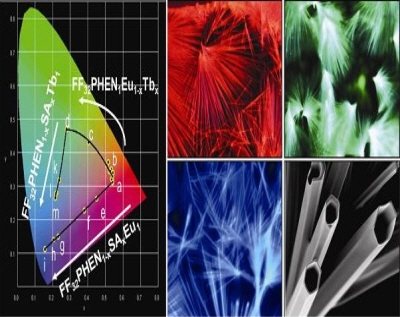
KAIST Professor Park Chan-beom develops multi-color 'bio-nanotube'
New material seen to have applications in biosensor chips, next-generation display devices. Study published in world-renowned materials journal, Advanced Materials. A research team (state-designated laboratory for new biomaterials) led by Prof. Park Chan-beom at the new materials department of the Korea Advanced Institute of Science and Technology said on April 27 that it has developed a nanotube material that can generate diverse fluorescent colors, including red, green, and blue, by using self-assembly technology existing in nature. The new material is expected to have applications as a biotechnology-based nanomaterial that can generate a wide-ranging color spectrum in various display devices. The self-assembly technology refers to a phenomenon that creates a specific structure or pattern on its own through weak non-covalent binding interaction between a material's components.The technology is one of the most widely studied techniques in the world at present. The nature of chemical materials assembling themselves like Lego blocks to create a three-dimensional structure is the fundamental basis for a wide range of biological phenomena, and the technology is highly sought after as a key technique for developing nanomaterials. Prof. Park and his team formed a nanotube structure one one-thousandth the size of a hair strand by allowing tens of thousands of very simple, two-amino acid peptides to self-assemble on their own. The team learned that in this process of self-assembly, photosensitization can be significantly magnified. Notably, the team used a protein plaque known as "amyloid," which has been linked to Alzheimer's Disease, as the peptide in its study,allowing it to successfully develop a new functional nanomaterial by applying the phenomenon of degenerative nerve diseases. The feat has drawn keen attention from the international science community. The new auto-assembly fluorescent nanomaterial is expected to have applications in the areas of biosensors, biochips, cell carriers for various drugs, medical hydrogels, and next-generation display devices, and will help Korea strengthen its science and technology competitiveness in the nano- and bio-fusion sectors. (Photo) The spectrum of fluorescent colors (left) generated by the KAIST research team and its bio-nanotube (right) The team has been conducting the internationally acclaimed study since 2008 thanks to government funding, part of the "government-designated laboratory program" operated by the Ministry of Education, Science and Technology. The study was published in the latest issue (April 27) of Advanced Material, a world-renowned material science journal. Experts say the study has made major contributions to the development of a new nanomaterial through the creative integration of nanotechnology and biotechnology. In recognition of the work's importance and applicability, Advanced Material listed the study in its "Advanced in Advanced" category, an honor awarded to the top 10 percent of the best science papers. Hello DD.comJung Yoon-hayhjeong at hellodd.com ? [May 06, 2009] - - - - - - -Source - HelloDD.com